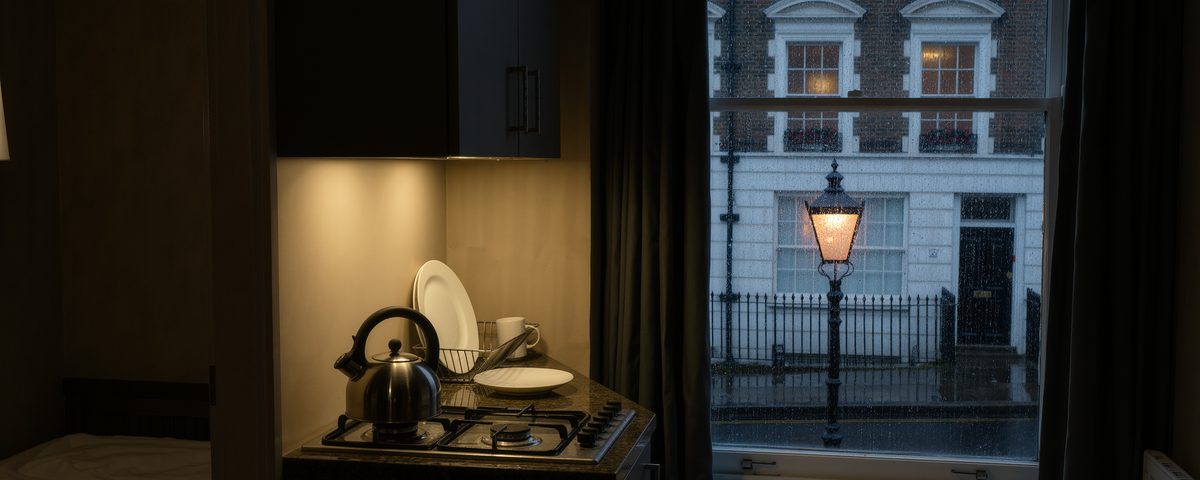
For four nights it does not matter. Book the hotel, use the gym you will not use, go home.
The question only becomes real somewhere around the ten night mark, which is also roughly where a work trip stops feeling like a trip and starts feeling like a way of living. At that point the choice of room is one of the few things you control, and it affects the evenings much more than it affects the days.
01What each one is actually like after two weeks
A hotel room is the most comfortable for a short stay and the hardest to live in. It is cleaned every day, which is a real benefit and also means you never fully unpack. The room is designed for sleeping and working and for nothing else, so any evening you spend in it is spent on the bed. Your food options are the hotel restaurant, room service or going out, and after ten nights the first two have become the same meal. The bar is downstairs, which is either useful or a slow problem depending on the person.
An aparthotel or serviced apartment gives you a kitchen, a washing machine and usually a table. The rooms are often plainer than a hotel of the same price and the service is lighter, typically a weekly clean rather than a daily one. The washing machine is a bigger deal than it sounds on a four week trip. The kitchen is the real change, and not because you will cook properly: it is because the alternative to going out becomes something you make rather than something delivered, and that removes the guilt that quietly builds up around eating badly for a fortnight.
A company flat or long let is the cheapest per night, the most like living somewhere, and the loneliest if the trip is a solo one. There is no reception, nobody knows you are there, and if you spend a Sunday in it you can go the whole day without speaking. For a three month posting it is usually right. For six weeks it often is not.
Digs or shared housing, which is common on construction, rail and infrastructure projects, is a different problem again and mostly solves the company question by force. The people are there whether you want them or not, which is either the best or the worst of these options.
02The trap in the aparthotel answer
Here is the part that gets left out of every comparison of this kind, and it matters.
The kitchen that makes an aparthotel better also makes it much easier never to leave. A hotel room is uncomfortable enough that at some point you go out. A studio with a kettle, a sofa and a laundry cycle running is a place you can quite happily stay in for eleven consecutive evenings, and a lot of people do, and then wonder why a six week trip felt like six months.
So the honest version is: the aparthotel is the better base and the worse default. It is the right choice if you also decide, separately, what gets you out of it.
03Location matters more than the type of room
Given a choice between a nicer room in the wrong place and a plainer one in the right place, take the plainer one. What is within a ten minute walk at seven in the evening decides your trip; the room only decides how you sleep.
- The City and Canary Wharf are the standard mistake for a long stay. Both are superb during the working day and go quiet after about eight, because nearly everyone there has gone home. If you are working in either, staying elsewhere and commuting in is worth considering.
- Borough, Bermondsey and Southwark have markets, small restaurants and the river, and are close to the City.
- Clerkenwell and Farringdon are walkable to the City and busy on a weeknight.
- Fitzrovia and Bloomsbury are central, well connected and calmer in the evening than Soho, which some people want and some do not.
- Anywhere with a high street rather than an office district. That is the actual test, and it is worth applying to whatever area your work puts you near.
04The practical checklist for a stay over two weeks
- A washing machine, or a laundrette within walking distance. Hotel laundry for a month is a startling number, and packing for four weeks is not the alternative you think it is.
- A table you can eat at that is not the bed. Surprisingly rare and surprisingly important.
- A window that opens, if you are there in summer. A lot of London buildings do not have air conditioning and a sealed room in July is genuinely unpleasant.
- Somewhere to buy food within five minutes. The kitchen is worth nothing if using it needs a bus.
- Check what the weekly clean actually is. Serviced apartments vary a lot, from a full service to a change of towels, and the listing does not always say.
05The short answer
Under a week, hotel. Over ten nights, a serviced apartment in an area with a high street, and then one decision a week about what takes you out of it. That second half is the part that does the work, and it is the part the accommodation choice cannot do for you.
06What we do, in one paragraph
KF.Social books you a seat at a table of six in a London restaurant, on a set evening, with other people who are also in London for work. It is 15 pounds for the seat, shown before you pay, and then your food and drinks at the restaurant. The restaurant lands about six hours before, and who you are sitting with about an hour before, which is when the group chat opens. Booking is open to anyone over 18 who pays. If your plans change, and on this kind of trip they do, cancelling 72 hours or more ahead puts the 15 pounds back on your card, and inside 72 hours it does not come back.
We only run in London, which is a real limitation and worth knowing before you look. If you are here, the tables coming up are here.
 KF.Social