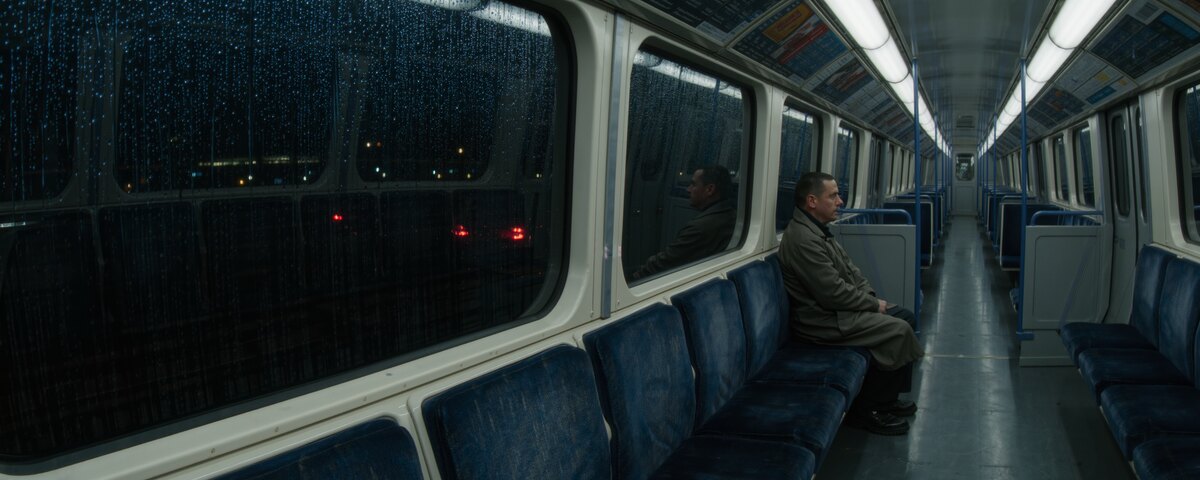
If your hotel is a five minute walk from the client site and forty minutes from anywhere you would actually choose to spend an evening, the problem is not the distance. It is that you have to decide before you leave the office, while you are still tired and still in your work clothes, and the honest answer at 18:10 is almost always no.
That is the whole mechanism. Everything below is about beating it.
01Why you ended up out there
Nobody books a hotel in Canary Wharf, by the Olympic Park or out near the airport because they want to. It happens because the travel policy optimises for the commute to work and for the nightly rate, and both of those point away from the middle of town. The person booking it is solving your mornings. Your evenings are not on the form.
It is a reasonable trade for a two night trip. Over three weeks it quietly decides how the whole trip goes.
02The number that actually matters
Not how many miles. Two things:
One, is the journey back a single train? A twenty five minute ride you can do half asleep with no changes is fine. A fifteen minute ride with two changes and a nine minute wait at the second one is worse, and you will feel it at eleven at night far more than you feel it at seven.
Two, does the last train home make you leave early? If the answer is yes, everything you do in town has a countdown attached and you will spend the last hour of it checking your phone. Find out the real answer for your line on a weeknight before you plan anything, because the difference between a service that runs past midnight and one that thins out at half eleven changes what kind of evening is available to you.
03What each kind of far actually costs
Canary Wharf and the docks
Better connected than its reputation. The Elizabeth line puts you at Liverpool Street in single figures and in the West End in under twenty, and the Jubilee line does London Bridge fast. If you are staying here, Shoreditch and the City are effectively local and you should stop thinking of yourself as being far out. The thing that gets people is the walk at the other end: the estate is large, and the ten minutes from your room to the platform is real time that does not show on any journey planner.
Stratford and the east
Also well connected, and genuinely quick into the City. The trap here is the opposite one. There is a lot immediately around you, most of it is a shopping centre, and it is entirely possible to spend three weeks eating within four hundred metres of the hotel and never once go anywhere. Convenience is what keeps you still.
West London and near the airport
This is the hard one. If you are out past Hammersmith or near Heathrow, central London is a real journey rather than a hop, and the back half of it at night is where the will goes. The honest advice is to stop trying to make weeknights work as though you were staying in town, and instead concentrate everything into fewer, better evenings. Two proper nights out in a week that you actually enjoyed beats five half attempts that ended in the hotel bar.
Croydon, Watford, the outer ring
Treat it as a different city with excellent trains. The mainline from these places is often faster and more comfortable than the tube from somewhere nominally closer, and it usually runs to one terminus, which makes the return leg simple. Simple is what you need at eleven at night.
04Four things that work
Do not go back to the hotel first
This is the single biggest one and it is almost mechanical. If the evening starts from the office, you are already halfway there and already out of the house. If it starts from your room, you have to leave the room, and after a long day you will not. Take what you need in the morning.
Decide on a weekday, not on the day
Pick which nights are your nights at the start of the week, when you are not tired, and treat them as fixed. Deciding on the night is deciding while tired, and tiredness always votes for the room. This is the difference between a plan and an intention, and it is worth more than any amount of willpower on a Wednesday.
Put the thing near the route, not near the hotel
The instinct when you are staying somewhere quiet is to find something local. Usually there is nothing, and the search is depressing. The better move is to pick somewhere on your own line, so that going is a shorter journey than coming back and the last leg is the easy one.
Use the weekend properly, if you are here for one
Distance is irrelevant on a Saturday. The forty minutes that beats you on a Tuesday is nothing at noon on a Saturday when you are not tired and nothing is waiting for you at eight the next morning.
05One option that fits this specific problem
Since the advice above is to book something with a time on it rather than trust yourself on the night, here is one thing shaped for exactly that, and the reasons are practical rather than general.
KF.Social runs tables of six in London on weeknight evenings, sitting at 19:00, and the London page lists the dates on sale with the night and the area for each. It is 15 pounds for the seat and you pay for your own food at the restaurant. There is no subscription, which matters when you are here for three weeks rather than three years.
Why it fits someone staying out of town in particular: 19:00 means you go straight from work rather than back to the room first, which is the part that actually defeats people. Shoreditch is quick from the east and from the Wharf, Soho is the middle of everything, and Clapham is the one to pick if you are south or south west. And because the seat is already booked and paid for, the decision was made on Sunday by somebody who was not tired.
The practical details, because a long commute makes timing matter: booking closes six hours before the sitting, so you can still book on the day. You are told the restaurant six hours before, which is enough to plan the journey, and who is at the table an hour before. If you cancel 72 hours or more ahead the 15 pounds goes back to your card, and inside 72 hours it does not come back.
06The thing to take from this
A hotel in the wrong place does not ruin a trip. It just means the default has moved, and the default is now the room. Everything here is one idea in different clothes: make the decision early, start the evening from the office, and give yourself an easy way home.
 KF.Social