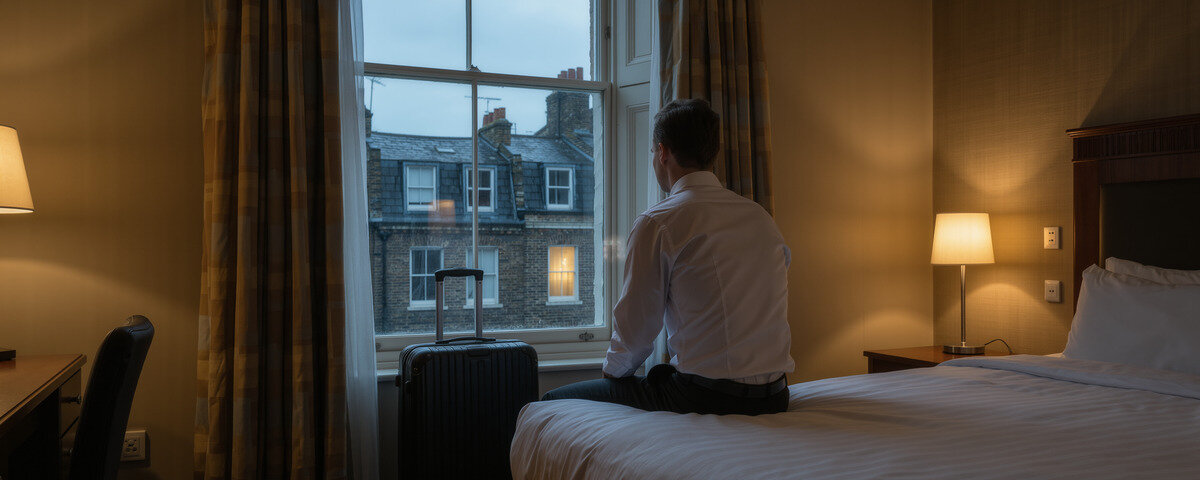
A business trip to London from the US: the ETA, the clock change, card fees, tipping, and why jet lag decides your first week of evenings. What to arrange before you fly.
By KF.Social·6 min read·Published 20th October 2026
You are flying over for a deal, a client engagement or a stretch at your firm's London office, and it might be ten days or it might be three months. From New York, Boston or Washington it is an overnight flight of about seven hours that lands in the morning; from the West Coast it is ten or eleven. London is five hours ahead of the East Coast and eight ahead of the West, most of the year.
The language is the same and the paperwork is light, so people prepare for it like a long domestic trip. The part that catches Americans out is the first week of evenings: jet lag decides when you are awake, and London decides when dinner is.
01Before you fly: the things worth ten minutes now
Get the ETA. US citizens visiting the UK without a visa now need an Electronic Travel Authorisation before they travel. It is applied for online and linked to your passport, and you should not leave it to the airport. If the trip involves more than meetings, ask your firm's travel or mobility team which permission the work actually needs, because that depends on what you will be doing, not on your passport.
Check the clock change. The UK and the US change their clocks on different dates. For a week or so in late October, and again in March, the gap to the East Coast is four hours rather than five, which moves every call you have with home. Check before you schedule the first week.
Your card will work, but check the fees. Contactless is how London pays for almost everything, including the Underground and buses, where you tap a card or phone on the reader. Use the same card to tap in and out every time. Check whether your card charges a foreign transaction fee before you use it for three months of dinners.
Plugs. The UK uses its own three pin plug at 230 volts. Most laptop and phone chargers handle the voltage and only need an adapter; hair dryers and anything with a heating element often do not.
Put one thing in the diary before you land. The trip that starts with an empty evening calendar and a plan to sort it out later is the trip where you eat room service every night.
02Week one: jet lag runs the evenings
Flying east is the hard direction. For the first few days you will probably be wide awake at four in the morning and fading by eight at night, which is exactly when London is sitting down to dinner. Restaurants are busiest from about half seven, and a dinner that starts at eight can feel like midnight on day two.
So do not judge the city, or your ability to have a social life in it, on the first three evenings. Eat early if you need to, get outside in daylight in the morning, and plan anything you actually care about for the second half of the first week, when your body has caught up. If you are on a deal team working late anyway, the jet lag will hide inside the hours for a while, and then land all at once on the first quiet evening.
03What is different about the evening
A lot of British working social life happens in a pub straight after work: standing, loosely organised, a round bought at the bar rather than a tab run by a server. It is a real way in and worth going to a few times. Nobody takes your order at the table in most pubs; you go to the bar and pay as you order.
In restaurants, the price on the menu already includes tax, so what you see is what you pay before service. A service charge, commonly 12.5 percent, is often added to the bill automatically. It is discretionary, and you do not need to tip on top of it. Where there is no service charge, around ten to twelve and a half percent for table service is usual. Tipping at a pub bar is not expected.
And one thing Americans often notice: British colleagues tend to go home. Your London counterparts may be friendly all day and gone at six, not because they are unwelcoming but because they have a train to catch and a family at the other end of it. If you were expecting the team dinner to be a standing arrangement, it probably is not.
04The expense account, and nobody to spend it with
On a long trip for a bank, a fund or a law firm, the money is usually not the problem. Dinner is budgeted. What there is not is anyone to have it with once the deal team has scattered, and a nice restaurant alone on a Tuesday is a different evening from a nice restaurant with company. Eating alone at a restaurant is completely normal in London, and a counter seat at a busy place is the easiest version of it. It is also fine to want something else some nights.
05The evenings, concretely
Decide before you fly that the second week has one fixed thing in it, midweek, that does not depend on anyone inviting you. Fixed, because a standing arrangement survives a late night on the deal. Midweek, because Tuesday and Wednesday are the evenings that stay empty.
A booked dinner is one straightforward way to do it. KF.Social seats you at a table of six at a London restaurant on a set evening. KF.Social runs tables of six in London on weeknight evenings, sitting at 19:00, and the London page lists the dates on sale with the night and the area for each. The seat costs 15 pounds, which pays for the matching and not for the meal, and you pay the restaurant for your own food and drink. Everything is in English, and the conversation is a table of six taking turns rather than a crowded bar.
The timings, because they matter when your week is not your own: booking closes six hours before, the restaurant lands about six hours before, and who you are sitting with about an hour before, when the group chat opens. If the week changes, cancelling 72 hours or more ahead returns the 15 pounds to your card, and inside 72 hours it does not come back. If the table does not run, everyone is refunded in full whatever the clock says. Booking gates on two things only: being 18 or over, and having paid. Everybody at the table booked and paid for their own seat exactly as you did.
Get the ETA before you fly, check the clock change if you are travelling in late October or March, and check your card's foreign transaction fee. Expect jet lag to wreck the first few evenings and do not draw conclusions from them. Read the bill for a service charge, go to the pub a few times, and put one fixed midweek evening in the diary for the second week, while you still have the energy to bother.
Related Questions
Do Americans need an ETA to visit the UK for work?
US citizens visiting the UK without a visa need an Electronic Travel Authorisation, applied for online before you travel. Whether your particular work is allowed as a visit is a separate question that depends on what you will be doing, so ask your employer's travel or mobility team if the trip involves more than meetings.
What is the time difference between London and New York?
Five hours for most of the year, with London ahead. Because the UK and the US change their clocks on different dates, the gap is four hours for a short period in late October and again in March. The West Coast is eight hours behind London for most of the year.
Do I need to tip in London restaurants?
Often a service charge, commonly 12.5 percent, is already on the bill. It is discretionary, and you do not need to tip on top of it. Where there is no service charge, ten to twelve and a half percent for table service is usual. Tipping at a pub bar is not expected, and menu prices already include tax.
How long does jet lag last flying from the US to London?
It varies from person to person, but flying east is usually the harder direction, and most people find the first few evenings difficult: awake very early, tired just as London sits down to dinner. Plan anything that matters for the second half of the first week rather than the first night.
Is it normal to eat alone at a restaurant in London?
Yes. Plenty of people eat alone in London restaurants, especially on weeknights, and counter or bar seating makes it easy. On a long business trip it can still get old, and a fixed midweek plan with other people is worth arranging before you arrive.
 KF.Social