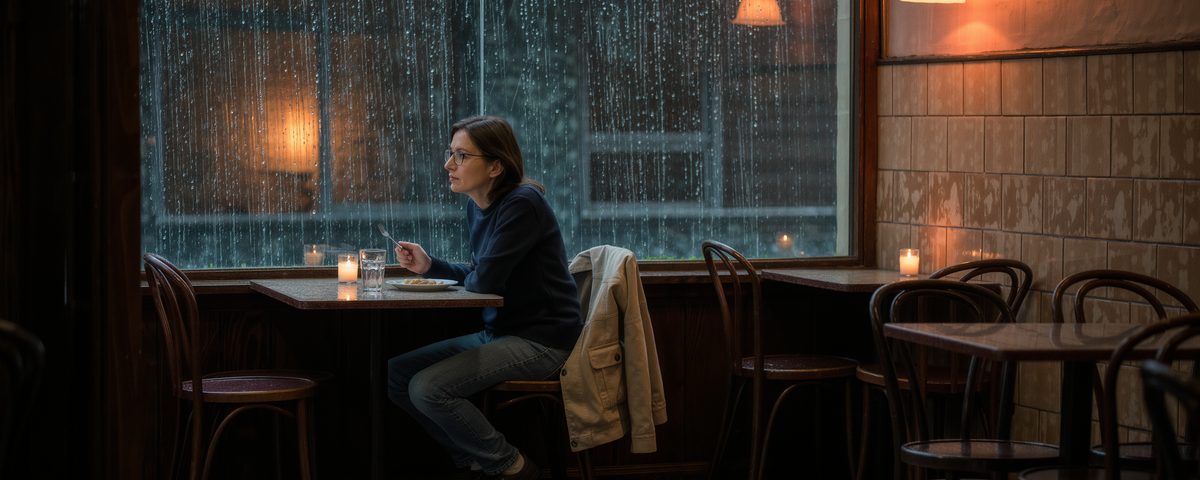
Eating alone at a restaurant in London is easier than it sounds, and easier in some rooms than others. Where to sit, when to go, and what actually happens when you ask for a table for one.
By KF.Social·6 min read·Published 15th September 2026
Nothing happens. That is the honest answer and it is worth having up front. You say a table for one, someone says of course, and you are sitting down about eleven seconds later. London restaurants seat people on their own every night of the week, and the staff have a script for it that is much better rehearsed than yours.
The difficulty is not the room. It is the twenty minutes before you leave the hotel, when going out requires a decision and staying in does not. So this page is mostly about lowering the cost of that decision: which rooms make it easy, when to go, and what to do with the part of the meal that has no food in it.
01The counter is the whole trick
If you take one thing from this page, take this. Eating alone at a counter is a completely different experience from eating alone at a table, and most people who decide they hate eating alone have only ever tried it at a table.
At a table for one you are a small group that is missing five people. The place setting opposite you is empty. You are facing a chair. At a counter you are facing the kitchen or the bar, in a row of people who are all also facing forward, and nobody in the room reads you as alone, because the person next to you is sitting exactly the same way.
London has an unusual amount of counter seating for a European city, and it is concentrated in recognisable kinds of place:
Ramen and noodle bars. Built for it. Fast, hot, no ceremony, and half the room is on its own.
Tapas and small plates bars. The format is designed around ordering a few things at a time, which suits one person better than a three course menu does.
Open kitchen counters. You get something to watch that is not your phone, which solves the hardest fifteen minutes.
Pub dining rooms. Underrated for this. A decent London pub will feed you properly at a small table and nobody will look at you twice, because pubs have always had people in them on their own.
Department store and market counters. Bright, busy, quick, and easy to walk out of if you decide you have had enough.
Walk-ins are realistic at a counter in a way they are not at a table. A restaurant that is fully booked for the evening will very often still put one person at the bar, which is worth knowing at half past seven on a Tuesday when everything looks full.
02Timing matters more than the restaurant does
The room you are dreading is a busy dining room at eight in the evening. You do not have to eat at eight.
Six to half past six. The room is half empty, the staff have time, and you will be out by half seven. The best slot for a first go.
Eight to nine. The peak, and the one that feels most exposed. It is also when the room has the most life in it, which some people want.
After nine. Genuinely good. The kitchen has relaxed, service is chattier, and late solo diners are completely ordinary in central London.
Monday and Tuesday are quieter and more forgiving than Thursday. If you are here on a Monday to Thursday pattern, that is convenient, because Monday is usually the night you have the least in.
03Where in London this is easiest
Some parts of town are much better at this than others, and it is not about the food.
Soho and Chinatown. Dense, fast, lots of counters, and busy enough that nobody is looking at anyone.
Borough and Bermondsey. Small rooms, good counters, and a short walk from most of the City.
Clerkenwell and Exmouth Market. Proper restaurants at a manageable scale, and a street rather than a strip.
The City and Canary Wharf. The hard ones. Both are built around lunch and both empty out after about eight, so a solo dinner there is quiet in the wrong way. If you are working in either, the useful move is to go one or two stops before you eat.
04The practical bits nobody tells you
Book, even for one. Most booking sites accept a party of one and it removes the doorway moment entirely.
Ask for the counter when you book. Some places will note it and some will not, but it costs nothing to ask.
Take something to read that is not a phone. A phone is fine and everyone uses one. A book or a paper reads differently to you, which is the only person it needs to read differently to.
Order in stages. One dish, then decide. It stretches the meal into something that feels like an evening rather than a task.
Service charge is usually already on the bill in London, typically twelve and a half per cent, and it is discretionary. Nobody expects anything on top.
Do not sit in a corner facing the wall. It is the instinct and it is wrong. Face the room or face the kitchen.
05The awkward part, said plainly
Being asked whether you are waiting for someone is the moment people dread, and it is worth having a flat answer ready so it does not land as a small blow. No, just me. That is the entire exchange. It is asked to work out how many covers to lay, not to make a point.
The other thing worth saying: eating alone at a restaurant is a genuinely good thing to be able to do, and doing it once takes most of the fear out of it. It is also not the same as company, and pretending otherwise is the bit that makes these articles annoying. If you are in London for work, on a stay long enough that the evenings have started to repeat, you are probably not looking for permission to eat alone. You have been doing it since Monday.
06What we do, in one paragraph
KF.Social books you a seat at a table of six in a London restaurant, on a set evening, with other people who are also in London for work. It is 15 pounds for the seat, shown before you pay, and then your food and drinks at the restaurant. The restaurant lands about six hours before, and who you are sitting with about an hour before, which is when the group chat opens. Booking is open to anyone over 18 who pays. If your plans change, and on this kind of trip they do, cancelling 72 hours or more ahead puts the 15 pounds back on your card, and inside 72 hours it does not come back.
We only run in London, which is a real limitation and worth knowing before you look. If you are here, the tables coming up are here.
Related Questions
Is it weird to eat alone at a restaurant in London?
No. London restaurants seat solo diners every night, and in central London it is common enough that staff have a standard, unremarkable way of handling it. Asking for a table for one takes about eleven seconds and then you are sitting down.
What is the easiest kind of restaurant to eat alone in?
Anywhere with a counter. Ramen and noodle bars, tapas and small plates places, and open kitchen counters are all built for one person, because everyone sits facing forward and nobody reads you as being on your own. A table for one is much harder work than a stool at a counter.
What time should I go if I am eating alone?
Six to half past six or after nine. Both are quieter than the eight o'clock peak, service has more time, and the room feels less like a stage. Monday and Tuesday are easier than Thursday.
Can I get a table for one without booking?
Often, especially at a counter. A restaurant that is fully booked for tables will frequently still seat one person at the bar, so it is worth walking in and asking even when the online booking says there is nothing.
Do I have to tip on top of the bill?
Usually not. Most London restaurants add a discretionary service charge to the bill, commonly twelve and a half per cent, and nobody expects anything further on top of that.
 KF.Social