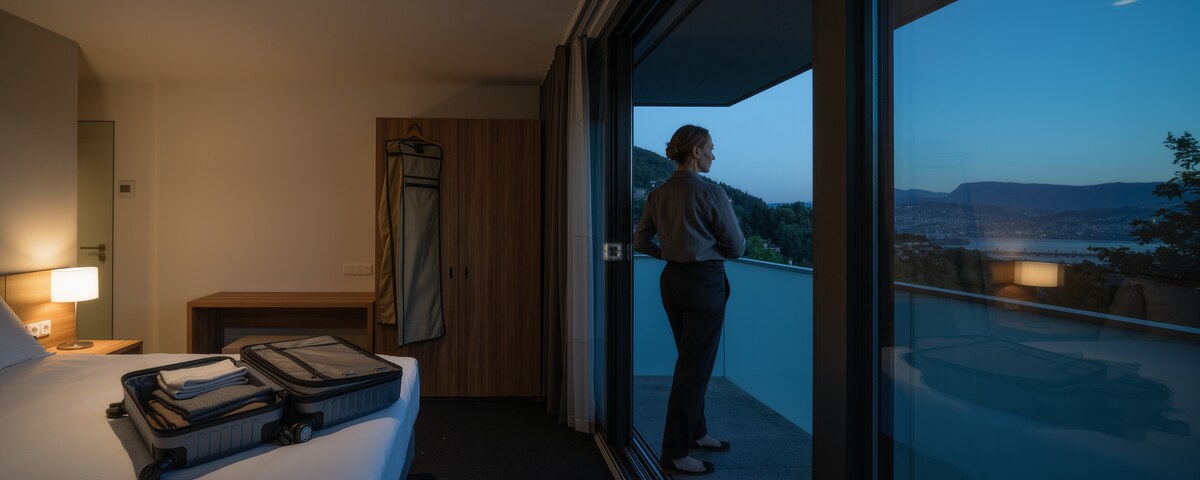
You are coming across from the Zurich, Geneva or Basel office for a few months, on a transfer, a project or a secondment. The company has sorted the paperwork, someone has found you somewhere to stay, and there is a desk with your name on it. On every measure that HR tracks, this is a solved problem.
The thing nobody hands over is the evenings, and on a transfer of this kind they are stranger than on an ordinary trip, because you have arrived with a whole professional life and no personal one, and the presence of the first disguises the absence of the second for about three weeks.
01The three things that are genuinely different
Distance, and what it does to plans. This is the big one. In Zurich or Geneva, a colleague suggesting a drink after work is proposing something that costs them fifteen minutes. In London, the same suggestion may cost somebody ninety minutes of travel on top of a full day, because they live in a different part of a very large city. So the answer is often no, and it is not about you. The consequence is that almost nothing here is spontaneous. Things are arranged a week or a fortnight out, and an evening that is not in the diary does not happen.
Punctuality is a range, not a point. Seven o'clock means roughly seven o'clock, and a train described as delayed may be delayed by an amount nobody can tell you. This is genuinely irritating for the first month if you are used to a timetable being a promise. The useful adjustment is to stop treating a late arrival as information about how much somebody cares, because it is not meant that way and reading it that way will make you think people are rude when they are not.
The money is differently distributed. London is not more expensive than Zurich across the board and it is much more expensive in the specific places that decide whether you have a social life: rent per square metre in a central area, and anything that involves a restaurant on a Friday. Meanwhile a lot of the everyday cost is lower than you expect. The trap is budgeting for the trip as though everything is cheaper and then finding that the part you actually wanted to spend money on is not.
02The secondee's specific problem
You are not an immigrant and you are not a tourist and you are also not a local hire, and there is no category for that. People who move somewhere permanently do the work of building a life because they have to. People visiting for a week do not need one. A transfer of three to twelve months sits exactly in the gap: long enough that the absence hurts, short enough that you keep telling yourself it is temporary and not worth the effort.
It is worth the effort. Six months is a long time to spend commuting between a desk and a flat, and the version of this that goes badly is not dramatic. It is somebody who works slightly longer hours each week because the alternative is going back to the flat, and who arrives home at the end of the posting having seen almost nothing.
03Before you come: the practical list
Push back on the accommodation if it is a hotel room and the posting is long. Company mobility teams default to a hotel because it is simple to book. For anything past a few weeks, somewhere with a kitchen and a table you can sit at is worth more than a better postcode. Ask; it is a normal request and it is usually cheaper.
Choose location by commute, not by map distance. Two places that look close together can be forty minutes apart. Look at how you would actually travel between where you sleep and where you work before you agree to anything.
Contactless, one card. You tap in and out of the Underground with a bank card or a phone, with nothing to buy in advance. Use the same card every time, because tapping in with one and out with another produces the maximum fare on both. Check the foreign card charges on a Swiss card, or use a UK one if the company provides it.
Sort the phone before you land. Swiss operators are not covered by EU roaming arrangements and the UK is no longer inside them either, so check your actual plan rather than assuming. A local SIM for a long posting is often much cheaper.
Ask what the team actually does on a Thursday, in week one. Not as a request to be included. As information. Some offices have a standing thing you can simply turn up to, and some have nothing at all, and knowing which one you have landed in tells you how much you need to arrange yourself.
04What to put in the diary
One fixed thing, midweek, inside the first fortnight, that does not depend on anyone inviting you.
Midweek is the part that matters. Tuesday and Wednesday are the genuinely empty nights on a posting like this, Friday usually has something attached to it, and the weekend is when you will be tempted to fly home. Fixed is the other part: a standing arrangement survives a day that overran, and a vague intention to do something social this week does not survive contact with a Tuesday.
A booked dinner is one straightforward way to do it. KF.Social seats you at a table of six at a London restaurant on a set evening. Dinners sit at 19:00 on weeknights, and the London page lists the dates on sale with the night and the area for each. The seat costs 15 pounds, which pays for the matching and not for the meal, and you pay the restaurant for your own food and drink.
Booking closes six hours before, the restaurant lands about six hours before, and who you are sitting with about an hour before, when the group chat opens. Cancel 72 hours or more ahead and the 15 pounds returns to your card, and inside 72 hours it does not come back. If the table does not run, everyone is refunded in full whatever the clock says. Booking gates on two things only: being 18 or over, and having paid. Everybody at the table booked and paid for their own seat exactly as you did.
The transfer is the easy bit and the evenings are the part nobody hands over. Expect a city where people live an hour apart and nothing assembles itself, expect times to be approximate, and expect the temporariness of the posting to be the excuse you use for six months. Get somewhere to stay that has a table in it, and put one recurring midweek evening in the diary early, while it still feels like effort worth making.
Related Questions
What is the biggest difference between working in Zurich and working in London?
Distance, and what it does to plans. In a compact city an after-work drink costs a colleague fifteen minutes, so it happens on the spur of the moment. In London the same suggestion can cost somebody ninety minutes of travel, so the answer is often no and almost nothing is spontaneous. Evenings here are arranged a week or two ahead or they do not happen at all.
Is London more expensive than Switzerland?
Not across the board, and that is what catches people out. A lot of everyday costs are lower than you expect, while the specific things that decide whether you have a social life, central rent and eating out, are expensive. Budgeting as though everything is cheaper tends to leave you short in exactly the places you wanted to spend.
Should I take the company hotel for a long secondment?
For anything beyond a few weeks it is usually worth asking for a serviced flat or an aparthotel instead. Mobility teams default to a hotel because it is simple to book, not because it is better for a long stay, and a place with a kitchen and a table changes the evenings considerably. On a long booking it is often cheaper as well.
Why does nobody in London seem to make plans on short notice?
Because the travel makes short notice expensive. People live a long way apart, so an unplanned evening asks somebody to add an hour or more of travel to a full working day. It reads as coldness from outside and it is mostly geography. The practical answer is to propose things further ahead and to accept that a diary is how this city organises its social life.
How long does it take to feel settled on a secondment to London?
Longer than the trip usually allows for, which is the reason to start early rather than to wait and see. The failure case is not dramatic: it is working slightly later each week because the alternative is an empty flat. One fixed midweek commitment inside the first fortnight is the single most useful thing, because it survives the days that overrun.
 KF.Social