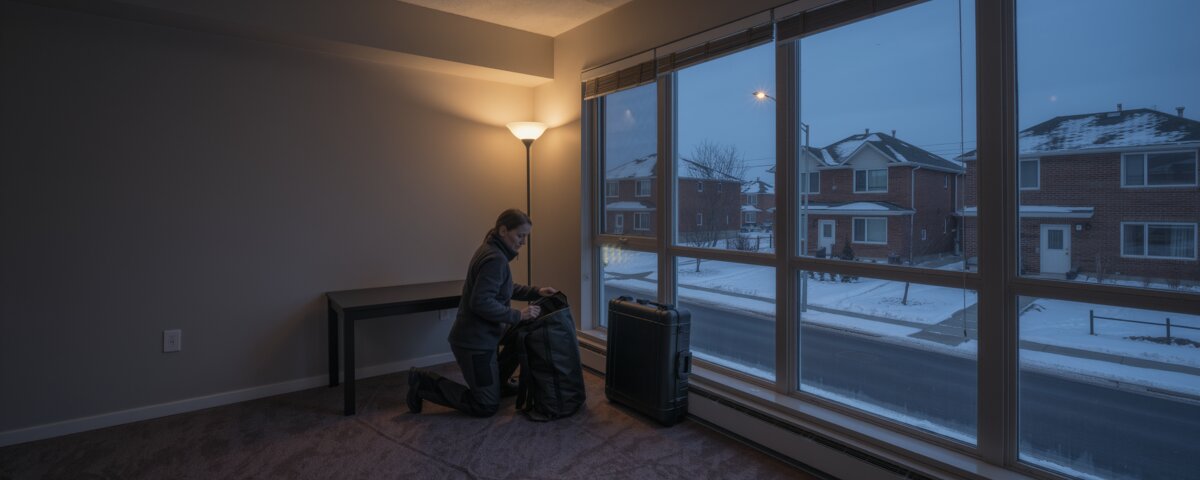
A business trip to London from Toronto or Vancouver means an overnight flight and a five to eight hour shift. What to arrange before weeks on a production or project.
By KF.Social·5 min read·Published 19th October 2026
You are coming over for a block of weeks: a production shooting in and around London, a project, a secondment, a run of client work that cannot be done from home. From Toronto or Montreal it is an overnight flight of around seven hours; from Vancouver or Calgary it is nine or more. London is five hours ahead of the east coast and eight ahead of the west, and the first few days will be partly about staying awake until a sensible hour.
After that the jet lag goes and a different question arrives. What do you do with the evenings when the day's work is over and everybody else goes home?
01Before you fly: the things worth ten minutes now
ETA or work permission, and know which. Canadians visiting the UK without a visa now need an Electronic Travel Authorisation before they travel. If you are coming to work rather than to attend meetings, and that includes most crew on a production, the employer or production should have arranged the right permission. Confirm which one you are travelling on before you get to the airport.
Find out where the work actually is. Many film and television studios, and a lot of industrial and research sites, are well outside central London. A base next to the studio makes a five o'clock call time bearable and leaves you a long way from anything when you wrap. If you have any say, choose somewhere on a direct line into town.
Phone and payments. Check your roaming charges before you land, because they can be steep on a long stay; a local SIM or an eSIM is often cheaper. London runs almost entirely on contactless card or phone payment, including the Underground and buses. Tap in and out with the same card every time.
Plugs and power. The UK uses its own three pin plug at 230 volts. Most phone and laptop chargers handle that without trouble, but check anything else before you plug it in, and bring two adapters.
Tipping is different. Restaurants often add a service charge, commonly 12.5 percent, to the bill. It is discretionary, and you do not need to tip on top of it. Bars do not expect a tip at all.
02The first week is jet lag, the fourth week is the evenings
Flying east overnight, most people land tired and spend the first few days waking at four and fading at eight. Get outside in daylight on the first morning and eat dinner at London time, early rather than late, and it passes within a week.
The harder part comes later and more quietly. On a production, the crew bond is real and the days are long, but when the day wraps most people go home, back to families, or to their own rooms, and a lot of the social life of a shoot happens on set rather than after it. In an office or on a project, colleagues who live here leave at six. Either way you find yourself at seven in the evening with energy you did not have in week one and nowhere in particular to put it.
That is the point, somewhere around the second or third week, when a stay stops feeling like a trip and starts feeling like living somewhere without any of the things that make living somewhere work.
03What helps on a long block
A kitchen and a table. For anything over a fortnight, an aparthotel or serviced flat beats a hotel room, because a hotel room gives you nowhere to be that is not the bed.
Use your day off on purpose. On a six-day week the one day off disappears into laundry and sleep unless something is booked for it.
Something physical with other people in it. A class, a climbing wall, a run club. It does not care what time you finished and nobody asks what you are working on.
One booked evening a week. Booked, because a long day wears through every vague intention.
04The evenings, concretely
A booked dinner is one straightforward way to fill that evening. KF.Social seats you at a table of six at a London restaurant on a set evening. KF.Social runs tables of six in London on weeknight evenings, sitting at 19:00, and the London page lists the dates on sale with the night and the area for each. It suits the weeks when your schedule is predictable, and it is honest to say it is no use on a night you are shooting late. The seat costs 15 pounds, which pays for the matching and not for the meal, and you pay the restaurant for your own food and drink.
The timings, because they matter when your week is not your own: booking closes six hours before, the restaurant lands about six hours before, and who you are sitting with about an hour before, when the group chat opens. If the week changes, cancelling 72 hours or more ahead returns the 15 pounds to your card, and inside 72 hours it does not come back. If the table does not run, everyone is refunded in full whatever the clock says. Booking gates on two things only: being 18 or over, and having paid. Everybody at the table booked and paid for their own seat exactly as you did.
From Canada the first week is about the time difference and the rest is about the evenings. Confirm your ETA or work permission, find out where the work actually is before you choose where to sleep, sort your phone before you land, and read the bill for a service charge. Then plan for the second and third weeks rather than the first: a kitchen, a booked day off, and one fixed evening a week that is not work.
Related Questions
What is the time difference between Canada and London?
London is five hours ahead of Toronto and Montreal, and eight hours ahead of Vancouver, for most of the year. The clocks change on slightly different dates in the two countries, so for a week or two in spring and autumn the gap is an hour smaller.
Do Canadians need an ETA to visit the UK?
Canadians visiting the UK without a visa now need an Electronic Travel Authorisation, applied for online before travel. If you are going to work rather than to visit, for example as crew on a production, you will usually need a different permission, which the employer or production normally arranges. Confirm which applies to you before you fly.
Do you tip in London like in Canada?
Less. Many restaurants add a discretionary service charge, commonly 12.5 percent, and you do not need to tip on top of it. Where there is no service charge, about ten to twelve and a half percent is usual for table service, and bars do not expect a tip.
Where do film crews stay when working on a London production?
Often near the studio, many of which are outside central London, because early call times make a short commute worth a lot. The trade-off is the evenings, so if you have any choice, stay somewhere with a direct line into the centre and a kitchen of your own for a long block.
 KF.Social