Making friends in your 30s in the UK and beyond: why it changes, what friendship needs, places that work from parkrun to choirs, and a twelve-week plan.
Say you are 37 and live in Nottingham. Your oldest friends are two hours away in three different directions. The friend you used to text on a Friday has a newborn and a new postcode. Your weekends fill up with other people's children's birthday parties, and the people you see most often are on a video call for work. Nothing has gone wrong. You have simply reached the decade in which friendship stops happening by itself.
This guide is written from the UK, with UK examples, but the pattern is the same in Leeds, Dublin, Toronto or Lisbon. Where something is UK-specific, there is an equivalent almost everywhere.
01Why your 30s are when it changes
School, university and your first jobs did the hard part for you: they put you in the same place as the same people, week after week, with time to spare. In your 30s each of those supports goes, often at once.
Couples pair off. Evenings become shared, and couples tend to socialise with other couples.
Children arrive, for some of your friends and perhaps for you, and spare time disappears.
People move, for space, for schools, for a cheaper rent, and distance quietly decides who stays in your life.
Work stopped being social. Hybrid and remote working removed the colleague you used to get lunch with.
The result is common and rarely said out loud. In England, 6.6% of adults say they feel lonely often or always (DCMS Community Life Survey 2024/25), and many more simply notice that their circle has shrunk without anyone meaning it to.
02What friendship actually needs
Sociologists who study friendship describe the same three conditions again and again: being physically near each other, meeting repeatedly without having to arrange it, and a setting that lets people relax. Your 20s supplied all three for free. Now you have to choose them.
Friendship also takes time. Research by Jeffrey Hall at the University of Kansas (2018) estimated around 50 hours together to move from acquaintance to casual friend and around 90 hours to become a friend. That is why a weekly thing works and a monthly one barely does.
03Places that work in the UK
parkrun. A free, timed 5k every Saturday morning in parks across the UK. Walking it is fine. The cafe afterwards and the volunteer rota are where people get to know each other. parkrun also runs in many other countries.
Walking groups. Ramblers has local groups across Britain, many with walks aimed at people in their 20s to 40s. Talking side by side is easier than across a table.
Team sport for adults who stopped. Social five-a-side, walking football, mixed netball leagues and back to netball sessions are built for people who have not played in years.
Community choirs. Many need no audition and rehearse weekly. Singing together is one of the fastest ways a group of people starts to feel like a group.
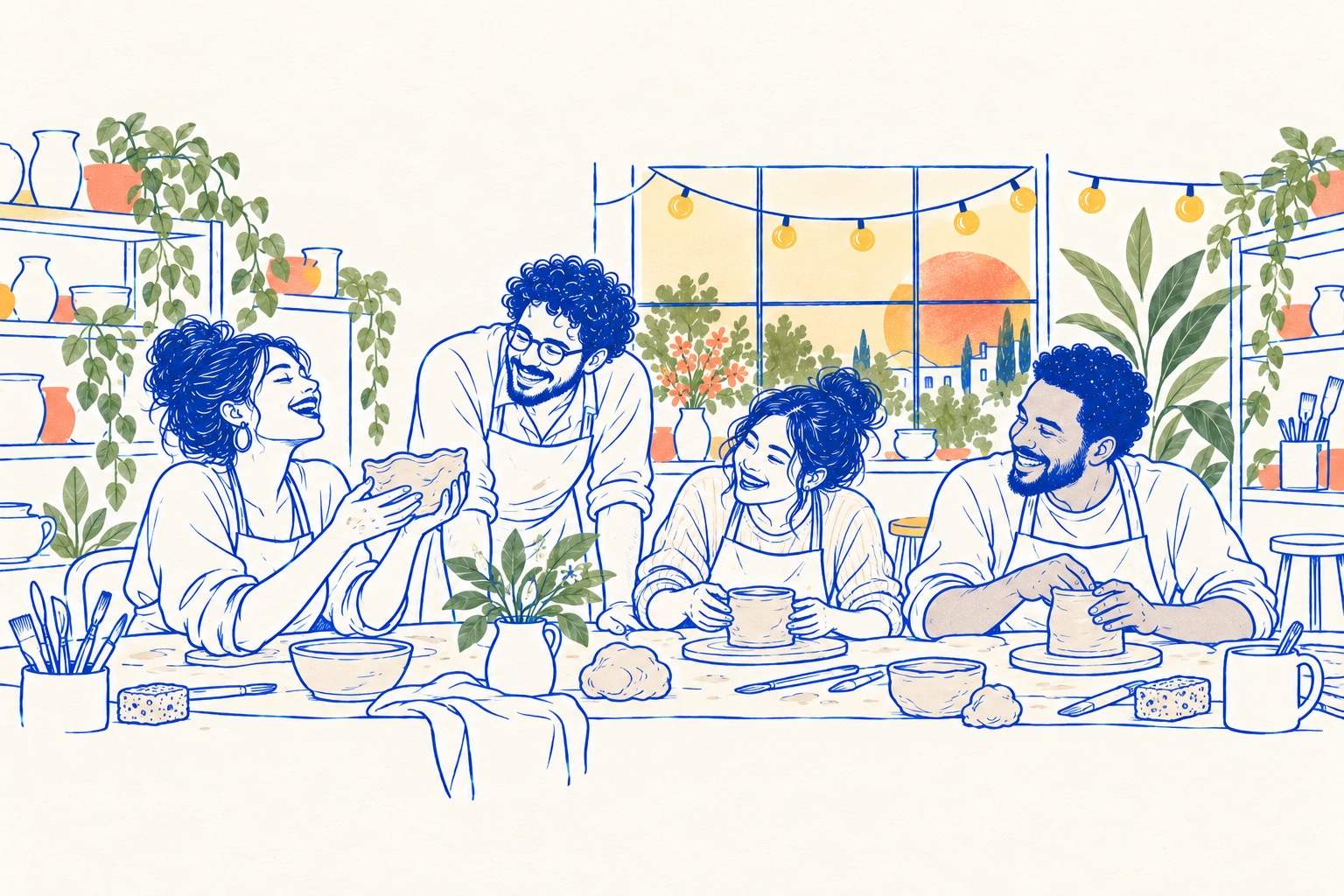
Evening and weekend courses. Adult education colleges and council courses run term-long classes in languages, pottery, woodwork and cooking. Ten weeks with the same people is close to ideal.
Volunteering. Your local Council for Voluntary Service lists regular roles. Park conservation days, food banks and community gardens give you a job to do and the same faces each time.
Pub quizzes. Weekly, local and low pressure. If you go alone, ask whether a team is short.
Climbing walls. Bouldering is social by design: you rest between climbs and talk to whoever is beside you.
Outside the UK the equivalents are easy to find: run clubs, hiking groups, language exchanges, community gardens and evening classes exist in nearly every city. The rule does not change: weekly, small, near home.
04A twelve-week plan
Week 1. Choose two recurring things within twenty minutes of home: one active, one sitting down. Put them in your calendar as if they were work.
Weeks 2 to 4. Go every time. Learn three names. Say something about last week ("did you get the knee sorted?").
Weeks 5 to 6. Suggest something small directly after: a coffee, a drink, the same walk at the weekend. Keep it attached to the thing you already do together.
Weeks 7 to 9. Pick the two or three people you like most and suggest something separate, with a date. "Next Thursday?" works better than "we should".
Weeks 10 to 12. Host something easy: a walk and a pub, a takeaway and a film, a board game night. Inviting people to meet each other is how a circle forms.
If you are in a couple and most of your friends are couples too, it is worth keeping one thing that is yours alone. See how to find couple friends for the other half.
Apps are a good way to find the weekly thing and to meet people outside your existing circles. Meetup lists interest groups, Bumble For Friends makes one to one introductions, Timeleft organises group gatherings in many cities, and KF.Social brings together people near you, clubs, chat and Plans.
On KF.Social, Discover suggests a small set of people each day, with plain reasons such as interests you share. You can send a friend request or a Super Wave with a message, join clubs with posts and a group chat, and join Plans, things you do with a small group of people, where they run near you. Whichever app you use, judge it by whether it gets you into the same room as the same people more than once.
07The honest part
The first few visits to anything are uncomfortable, and in your 30s you have less patience for discomfort than you used to. Go anyway, four times, before you decide. By the fourth week you are no longer new, and that is when it starts to feel like yours.
Related Questions
Is it normal to have few friends in your 30s?
Yes. In your 30s the things that used to supply friends, school, university, shared houses and the office, fall away, often at the same time. Many people notice their circle has shrunk without anyone meaning it to. It is a change in circumstances, not a verdict on you.
What is the best way to make friends in your 30s in the UK?
Pick something weekly, small and close to home, such as parkrun, a Ramblers walk, a community choir, a term-long evening class or a regular volunteering shift, and go at least four times. Repetition with the same people is what turns acquaintances into friends.
How long does it take to make a new friend as an adult?
Research by Jeffrey Hall (University of Kansas, 2018) estimated around 50 hours together to become casual friends and around 90 hours to become friends. Seeing someone weekly gets you there in a few months.
How do you make friends in your 30s without drinking?
Use morning and daytime formats: parkrun, walking groups, climbing walls, classes, volunteering and coffee after any of them. Plenty of people in their 30s drink less than they used to, so you will not be the only one.
Do friendship apps work in your 30s?
They can, if you use them to get into the same room as the same people more than once. Meetup, Bumble For Friends, Timeleft and KF.Social each do this differently; judge them by whether they lead to a second meeting.
 KF.Social