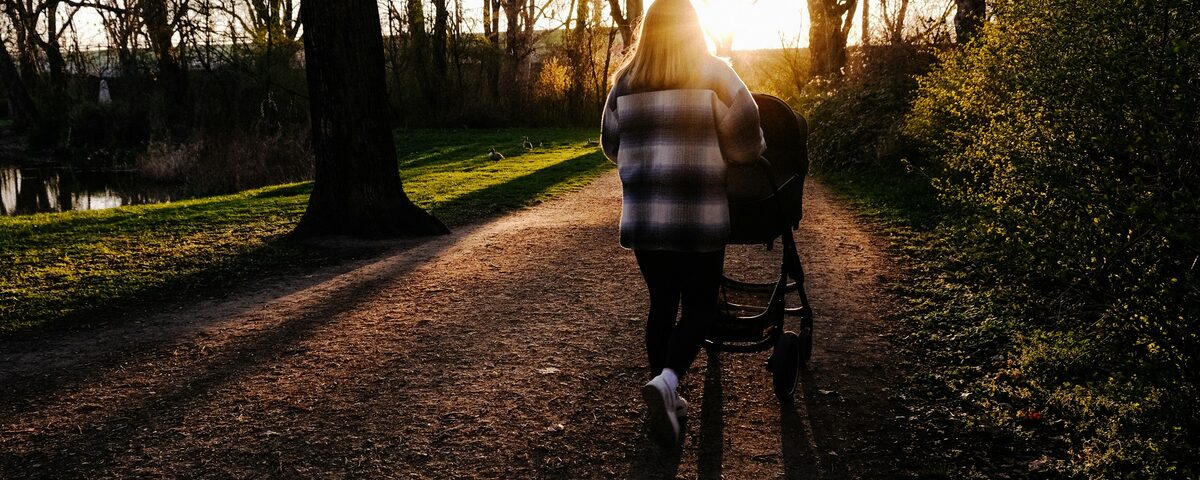
The first walks with a newborn are mostly about leaving the house at all. What to take, how to plan for turning back, and why one person to walk with matters.
The first few walks are not really about walking. They are about the fact that leaving the house has become a forty minute operation with an uncertain outcome, and that some days it does not happen at all.
01Lower the target until it is achievable
The most common mistake is setting out to do a proper walk, failing twice and concluding that going out is not currently possible. The end of the road counts. Once round the block counts. The point of the early ones is to prove to yourself that the door is passable, not to cover ground, and a short walk you actually do beats a good one you keep postponing.
It helps to decide in advance that turning back is a successful outcome rather than a failed walk. Nobody is measuring, and a walk that lasted eight minutes still got you out of the room.
02Timing and turning back
Go after a feed if you can, and assume the schedule will be wrong anyway. Plan a route where you are never more than ten minutes from home, which in practice means small loops close to the house rather than one longer route. If you are aiming somewhere, aim at something with a door: a cafe, a library, a shop. Having somewhere to go inside changes what happens when the weather turns or the baby does.
Do not plan around a fixed arrival time in the first weeks. An arrangement to meet someone at eleven is a source of pressure. An arrangement to meet someone who is happy to wait, or to walk their own loop until you appear, is not.
03What to take
More layers than the weather suggests, for you as much as the baby, because walking slowly is colder than walking normally.
Nappies, wipes and a changing mat, kept permanently in the bag so leaving requires no packing decision.
A spare set of clothes, and something for you if you are feeding.
Water and something to eat one-handed. This is the item people forget and regret.
Rain cover on the buggy, always, because it lives there and weighs nothing.
A charged phone. Not for the walk, for the twenty minutes you may end up sitting on a bench.
Anything about the baby, feeding, sun, heat, sleeping in a buggy or when it is sensible to be out is a question for your midwife or health visitor rather than for a guide about walks. They will answer it in a minute and it is what they are there for.
04Why one other person is the whole point
Of all the social contact available in the first year, a walk with one other person is the cheapest and the most robust. It costs nothing. It needs no booking. It can be moved by an hour without anybody minding. It works if your baby sleeps through it and it works if your baby screams through it, which is not true of a cinema, a restaurant or anyone's living room.
It also solves the conversation problem. Walking side by side means nobody has to hold eye contact or be entertaining, and long gaps are normal rather than awkward. In a year when you are short of sleep and short of small talk, that is the difference between contact you can manage and contact you cancel.
05Getting someone to walk with you
Ask specifically. A day, a time, a meeting point. "We should go for a walk sometime" produces nothing.
Make it weekly from the start. Same day, same time. Then it does not have to be arranged again, which is the thing that kills most of these.
Say the honest terms out loud. That it might be short, that you might be twenty minutes late, that you may have to stop. Anyone who is fine with that is the right person, and saying it removes the reason to cancel.
Ask people at the same stage, and people who are not. Someone else with a newborn understands the terms without explanation. Someone whose children are grown often has more free daytime than anyone and is rarely asked.
Keep the slot even when the other person cannot come. Go anyway. The habit is worth more than the company on any single week, and the company comes back.
Related Questions
How soon can you take a newborn out for a walk?
That is a question for your midwife or health visitor rather than a guide, and they will answer it quickly. What is worth planning either way is the practical side: short loops close to home, a turn-back point, and a bag that stays packed so leaving requires no decisions.
How long should the first walks be?
Short enough that you will actually do them. The end of the road counts and once round the block counts. Decide in advance that turning back early is a successful outcome, because the aim in the first weeks is proving the door is passable rather than covering distance.
What should I take on a walk with a newborn?
Nappies, wipes and a changing mat kept permanently in the bag, a spare set of clothes, more layers than the weather suggests because walking slowly is cold, water and something you can eat one-handed, the rain cover, and a charged phone for the twenty minutes you may spend on a bench.
Why is walking with someone else so useful in the first year?
Because it is the most robust form of social contact available. It is free, needs no booking, can be moved by an hour, and works whether the baby sleeps or screams. Walking side by side also removes the pressure to hold a conversation, so long silences are normal rather than awkward.
 KF.Social