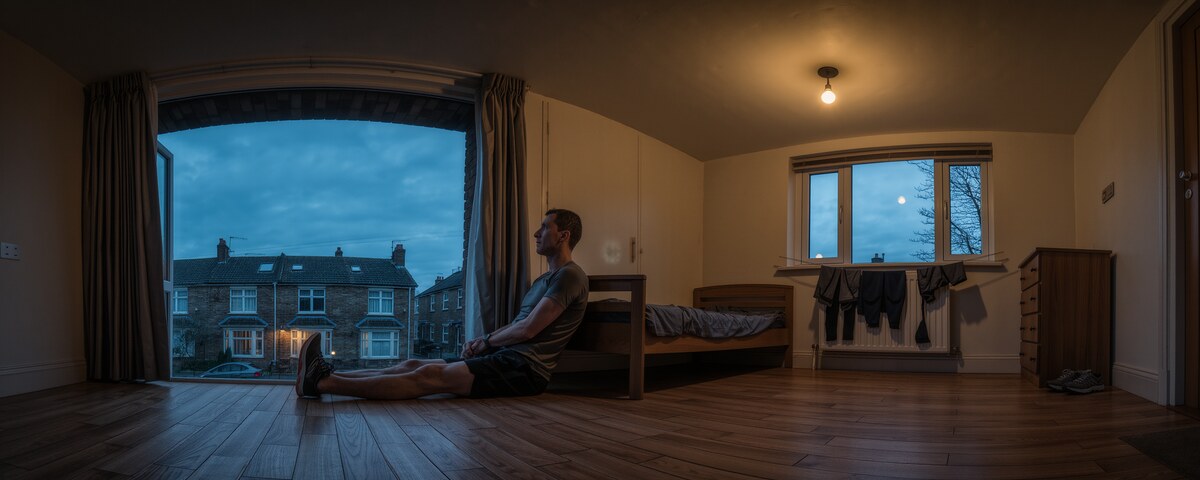
Weeks in London for a training camp or a competition build. The evenings are empty and constrained at the same time. What actually fits around early starts.
By KF.Social·5 min read·Published 14th October 2026
This guide is by KF.Social, an app for making friends where you live: you join a small group doing something you enjoy.
You are here for six weeks, or ten, or a season. The training is the reason and the training is handled: there is a programme, a coach, a facility and a schedule that somebody else wrote. Your day has more structure in it than most people's month.
And then it stops, at about six in the evening, and the rest of the night is yours in a city where you know nobody. A training block is the unusual case of having a great deal of empty time and almost no freedom in how to spend it, and the second half is the part nobody accounts for.
01The constraint is not loneliness, it is the timetable
Most advice about being new in a city assumes the evening is open. Yours is not. If the alarm is set for half five, an evening that ends at eleven costs you tomorrow's session, and tomorrow's session is the reason you are in the country. That single fact removes most of what a city normally offers a newcomer.
It is worth being precise about what it removes, because the answer is nearly everything by default:
British social life after work runs on the pub, and the pub runs on drinking. You may not be drinking at all during a block.
Restaurants get going late. A table at half eight is a normal booking here and it is a bad idea the night before a hard morning.
Anything described as a night out is, structurally, a late night.
Your food is not entirely your own decision, which quietly rules out a lot of spontaneous eating.
So the common outcome is that people conclude there is nothing they can do and spend ten weeks between a facility and a room. That is a reasonable conclusion from the evidence and it is still the wrong one.
02What actually fits
The filter is not what sounds appealing. It is three practical questions: does it start early, can you sit down, and does it finish at a time you know in advance.
An early dinner is the most underrated option here, because it satisfies all three. Something at seven that is over by ten is compatible with almost any programme, which is not true of anything that starts at nine.
Anything with a fixed end time. A film, a play, a comedy set, a gig with a stated finish. The value is not the culture, it is that you can see the exit from the start.
Things that are structurally sober. A climbing wall, a pool, a cinema, a gallery late opening, a quiz. Nobody will comment on what you are drinking and you will not spend the night explaining yourself.
Not a run club, at least not as your social plan. It is the obvious suggestion and it is usually wrong: it is more training, at the wrong intensity, on a day your programme already accounted for. If you want to go, go, but do not count it as the evening that was supposed to be the break.
03The rest day is the one to use properly
This is the practical centre of it. A block has a rest day in it, and rest days get spent asleep, on a phone, and alone, which restores the body and does nothing for the rest of it.
A rest day, or the evening before a light morning, is the one slot in the week where an ordinary evening costs you nothing at all. It is genuinely the only time the trade-off disappears. Protecting it for recovery and then spending it doing nothing is a waste of the one night you had.
04The other thing, which nobody says out loud
Training blocks are socially strange in a specific way. You are surrounded by people all day, so from outside it looks like the opposite of isolation, and every one of those relationships is arranged around the work: coaches, staff, and people you may well be directly competing with. It is company and it is not the same as friendship, and the gap between the two is easy to miss until a bad week.
The evenings are where the difference shows up. Having one thing a week with people who have no view on your performance and no stake in it is genuinely useful, not as a treat, but because it is the only part of your week in which you are not being assessed.
05Where a booked dinner does and does not fit
KF.Social seats you at a table of six at a London restaurant on a set evening. Dinners sit at 19:00 on weeknights, and the London page lists the dates on sale with the night and the area for each. The seat has its own price, shown in the app before you book, which pays for the matching and not for the meal, and you pay the restaurant for your own food and drink, so you order what suits you.
The honest part: a sitting is about three hours. A 19:00 dinner is a good evening before a rest day or a light morning, and a poor one before a hard session at six. That is a real constraint and it is better said plainly than discovered at half past nine. Pick the night against your programme rather than against the calendar.
The timings, since a block moves: booking closes six hours before, the restaurant lands about six hours before and the table about an hour before, when the group chat opens. Cancel 72 hours or more ahead and the seat price returns to your card, and inside 72 hours it does not come back. If the table does not run, everyone is refunded in full whatever the clock says. Booking gates on two things only: being 18 or over, and having paid.
You have the empty evenings and not the freedom, and the city's defaults are late and built on drinking, so most of them are unavailable. Judge things by whether they start early, let you sit down and end at a known time. Do not count training as your social plan. And use the rest day, because it is the only night in the week when an ordinary evening costs you nothing.
Related Questions
What can you do in the evening on a training camp?
Judge options by three things rather than by appeal: does it start early, can you sit down, and does it finish at a time you know in advance. An early dinner, a film or a play with a stated end time, a climbing wall, a pool or a gallery late opening all pass. Almost anything described as a night out fails, because it is structurally late.
Is a run club a good way to meet people during a training block?
It is the obvious suggestion and usually the wrong one. It is more training, often at the wrong intensity, on a day your programme has already planned for. Go if you want to go, but do not count it as the evening that was meant to be a break from the work, because it is not one.
How do you socialise when you are not drinking?
Choose settings that are not organised around alcohol in the first place, so that nothing needs explaining. A cinema, a climbing wall, a quiz, a gallery late opening or a meal in a restaurant all work, because in none of them does anyone notice what is in your glass. The problem with a pub is not the drink, it is that the drink is the activity.
Why does a training camp feel isolating when you are around people all day?
Because the relationships are all arranged around the work. Coaches, staff and training partners are company, and several of them have a direct stake in how you perform or are competing with you. It looks like the opposite of isolation from outside, and the gap usually only shows up in a bad week. One evening with people who have no view on your performance is useful for exactly that reason.
Is a three hour dinner compatible with an early start?
Not before a hard session. A 19:00 sitting running about three hours is fine before a rest day or a light morning and a poor idea before a six o'clock start, so pick the night against the programme rather than the calendar. The rest day, or the evening before one, is the slot where an ordinary evening costs nothing at all.
 KF.Social