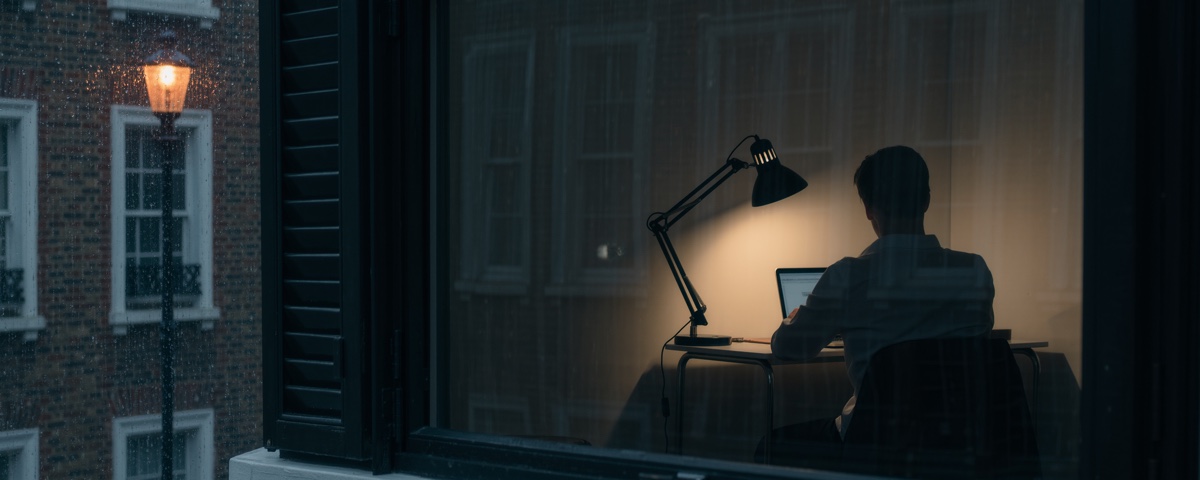
The strange thing about being on assignment is that you spend the whole day talking to people and end it having spoken to nobody.
Interviewing is a conversation shaped like work. You are listening for the quote, steering, keeping the other person comfortable and yourself invisible. Doing it for eight hours uses the same muscle that a normal evening would, which is why reporters get back to the flat wrung out and with nothing left for company, and then file until one.
If you are in London for a few weeks doing this, here is the honest version of what works.
01Sources are not company, and it matters more than it sounds
Some of the best evenings of a posting are with people you met through the work. They are also not off duty, and pretending otherwise is how reporters end up in trouble on two fronts at once.
The practical cost is smaller and more constant than the ethical one. If everyone you see in a city is connected to a story, then every evening is still the story, and you never get the hours that make you a person who can write rather than a machine that transcribes. That is not a moral point. It is why the third week is harder than the first.
02The freelance version is worse
Staff correspondents at least have a bureau, which is a room with people in it who complain about the same things. Freelance on assignment you have a flat, a laptop and an editor in another timezone who replies at eleven at night.
Two things follow. Your working day has no edges, so it expands until it touches both ends. And nobody notices if you do not leave the flat for two days, so nothing external stops it. Anyone who has done a long stretch of this knows the feeling of realising it is Thursday.
The countermeasure is something with a time on it that you did not choose.
03What fits the shape of the job
Accept that the evening is the filing window, and defend a different one
You are not going to win back seven till eleven on a filing night. Do not try. Pick the night in the week where the deadline pressure is lowest, which on a weekly cycle is usually right after you file, and protect that one.
Choose things that do not require you to explain yourself
A class, a swim, a table booked for a fixed hour. The reason is small and real: when you say what you do, people become interesting or careful, and either way you are working again. Something with a task in it lets you be there without being a journalist for two hours.
Do not build your whole stay around the press crowd
Foreign press clubs and correspondent drinks are useful and worth doing. They are also shop. An evening comparing bureaus and rates is enjoyable and it is not time off, and if it is your only social outlet, you will leave London having only met your own profession.
One evening where you are not the one asking
This is the thing that actually resets it. Sit somewhere you did not arrange, with people who do not know what you do and are not going to be in anything you write, and let somebody else run the conversation.
If you want the logistics handled: KF.Social runs tables of six in London on weeknight evenings, sitting at 19:00, and the London page lists the dates on sale with the night and the area for each. It is 15 pounds for the seat and you pay for your own food at the restaurant, with no subscription, which matters when you do not know where the next assignment is. Booking closes six hours before the sitting, the restaurant lands six hours before and who is at the table an hour before.
On cancelling, because assignments move: outside 72 hours the 15 pounds returns to your card, and inside 72 hours it does not return. If a breaking story eats your week, that is the rung that will cost you, so book the night least likely to be swallowed.
04The part that is genuinely hard to fix
Some assignments are heavy. If you are reporting something distressing, the isolation is not a scheduling problem and an evening out will not touch it, and it would be glib to suggest otherwise. What helps there is people who understand the work, which usually means calling home rather than meeting somebody new, and taking seriously that a difficult posting is a thing to be supported through rather than got through.
For ordinary assignments, though, the problem really is just structural: irregular hours, a strange city, and a job that uses up exactly the capacity a social life needs. A fixed weeknight is a small answer, and it is the one that holds.
 KF.Social