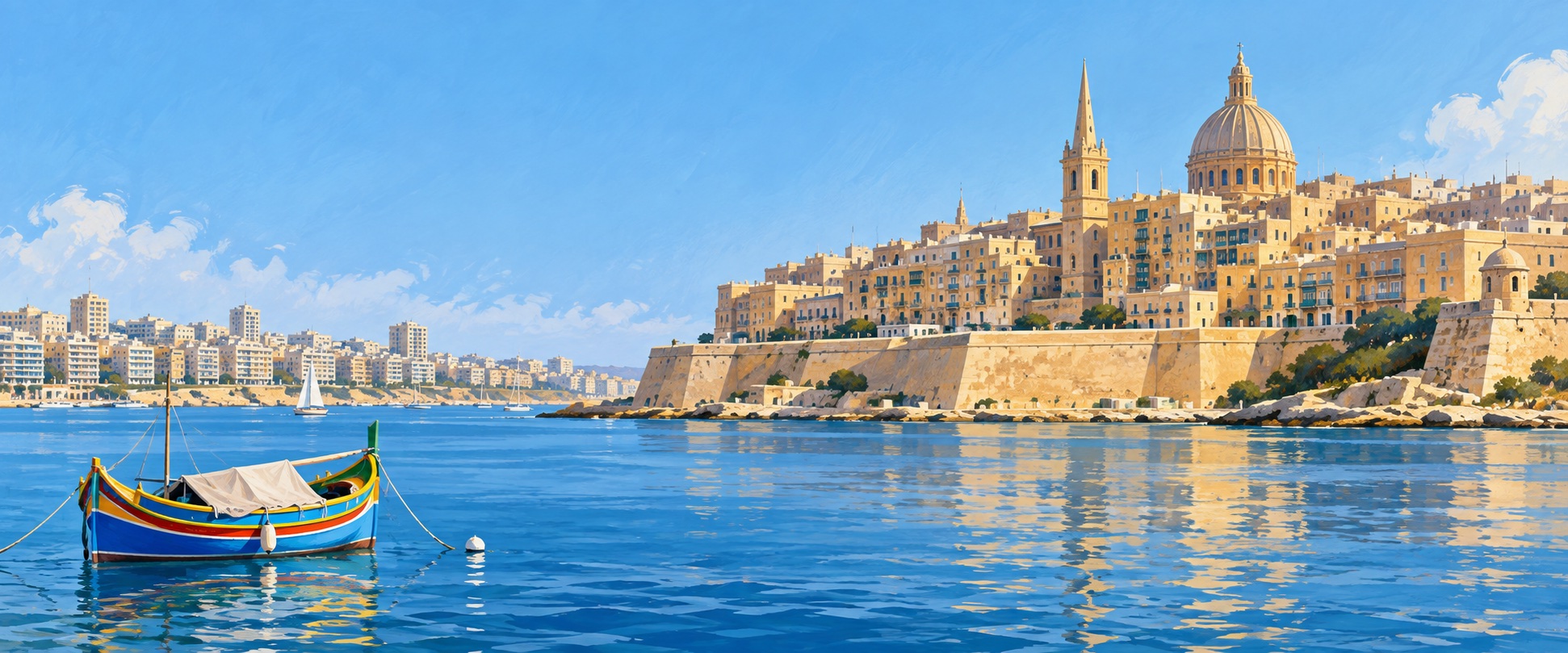
Whether you have lived in Malta for years or are still learning which side of the harbour you are on, the easiest way to turn a first conversation into a familiar face is often to meet again around a shared activity. Start with the part of the island you can get home from comfortably, then choose a group or programme that welcomes new participants.
01Choose the harbour side you can reach regularly
Valletta, Sliema and St Julian’s are separate localities around Malta’s central harbour area. Valletta sits between Marsamxett Harbour and the Grand Harbour; Sliema faces Valletta across Marsamxett, and St Julian’s lies farther north along the coast. A map can make the area look compact, but your actual journey depends on where you start, the time, the bus or ferry timetable, and the walk at either end. Before signing up for an evening activity, check the return trip for the day it meets. A daytime first visit can be a sensible way to learn the route.
Think in terms of the part of the harbour you already cross for work, study, errands or friends. Valletta is a natural starting point for public cultural programmes; Sliema and St Julian’s have their own neighbourhood routines and connections. This guide treats them as one editorial area because they are linked by everyday travel, not because every journey between them is effortless.
02Try volunteering if you want a shared role
The Malta Council for the Voluntary Sector’s voluntary service listings let you browse roles from voluntary organisations and apply for one that fits your interests. The council says an organisation contacts applicants to meet and discuss starting the role; the listing is a route into a real group, though the activity, location, screening and commitment vary by organisation. If nothing fits today, the service says applicants can receive weekly updates about new opportunities.
For an island-wide route into event volunteering, Voluntiera Malta mobilises volunteers for activities across culture, the environment, social issues, animal welfare and sport. Read each role carefully and ask what a typical shift involves. A defined task can make arriving alone easier because you have something practical to do together.
03Use arts programmes as a reason to come back
For a hands-on routine, the Malta Society of Arts’ Art for Leisure course is an adult introductory visual-arts option at Palazzo de La Salle in Valletta. Seasonal sessions give you a reason to return to the same place and work alongside other learners; it is a class, not a hosted social group, so conversation will depend on the session. The schedule and enrolment change by term, and popular classes can fill, so check the current details before planning around one.
Spazju Kreattiv at St James Cavalier in Valletta publishes a changing programme across film, theatre and visual art. Its programme changes during the year; workshops or participatory events can offer more conversation than a performance. Check the event page for registration, audience and access details, and look for another session before treating a one-off visit as a routine.
If you are interested in dance, ŻfinMalta’s participation programme describes opportunities for people ranging from curious audience members to dance beginners and artists. Activities change, and individual sessions may have forms or other requirements, so check the current programme before travelling. A beginner-friendly workshop can give conversation a natural starting point, even if you arrive without knowing anyone.
04Make the second visit part of the plan
Pick one activity that is realistic on an ordinary week, not just on a free Saturday. Check its location and finish time against the last useful bus or ferry, and allow for the walk between the venue and stop. If a route depends on a harbour crossing, check the operator’s live timetable for that evening; services and seasonal hours can change. Malta Public Transport’s timetable and journey planner can help with buses, while Transport Malta’s Grand Harbour and Marsamxett ferry information explains the cross-harbour services.
After a first session, ask someone whether they are going again, or choose the next date while you are there. A repeated activity gives people time to recognise one another; it does not guarantee instant friendship, and it is fine to try a different group if the format or journey does not suit you.
05What to check before you go
- Does the organiser welcome new adult participants, and is advance registration required?
- Will people be talking or making something together, or is this mainly a performance to watch?
- Can you make the return journey at the actual finish time, including your walk home?
- Is the format comfortable for you, including language, accessibility, alcohol and group size?
- Could you realistically come back next week or next month?
Malta’s central harbour localities offer several different ways to enter a group, from a volunteer role to a creative programme. Choose one that fits your normal week and your route home; showing up again is often more useful than collecting a long list of places.
06Sources checked 29 September 2026
 KF.Social