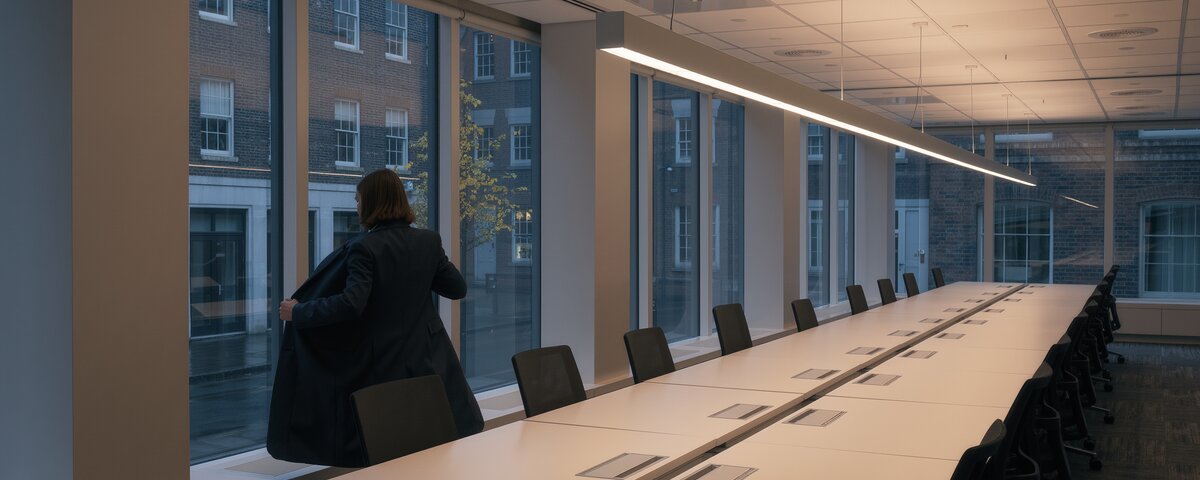
You are the only person from your firm on this one. Everyone else on the engagement works for the client, lives in or around London, and leaves the building somewhere between half five and half six to go home to a partner, a flat or a train. You go back to a hotel. That is the whole shape of a solo-staffed trip, and it is worth naming because it is different from the usual version of being in London for work.
A team from your own firm solves the evenings badly, but it does solve them. There is always somebody to get dinner with, a standing joke about the hotel, a shared complaint about the client. Take that away and the evenings are entirely yours, which sounds fine in week one and stops being fine at about the point the stay crosses ten days.
01Why the client team is not the answer, even when they are lovely
Client teams on a long engagement are often genuinely warm, and you should say yes to the first few things they suggest: the leaving drinks, the Thursday pub, the team lunch. It is part of the job and it makes the job easier.
But there are three honest reasons it cannot be your whole social life. The first is that they have lives here and you are a guest in them; most of the time the evening they would spend with you is an evening taken from somebody at home. The second is distance: you may be reviewing their work, recommending changes to their team or reporting on their numbers, and a friendship that forms across that line is awkward for both of you when the report lands. The third is simple arithmetic. The invitations come in the first fortnight and then thin out, not because anyone has gone off you but because the novelty of the visitor wears off and ordinary life resumes.
So treat the client team as colleagues who are sometimes also company, and not as the plan.
02Your own firm is a call, not a colleague
When you are staffed alone, contact with your own side tends to shrink to a weekly check-in with the engagement lead and a stream of messages about the work. It is worth asking for a little more than that, and it is a perfectly normal thing to ask for: a proper call once a week that is not only a status update, or a visit from somebody senior partway through. None of it will fill a Tuesday night, but it does stop the trip feeling like you have been posted somewhere and forgotten.
If anyone else from the firm is in London on a different project, find out. A dinner with somebody from your own side, once, is worth more than it sounds, because it is the one conversation all week where you do not have to be the representative of anything.
03The practical things that decide the evenings
- Where you sleep relative to the client. If the client office is out at a business park, a hotel next door makes the mornings easy and the evenings empty. If there is any choice, a hotel near a line into the centre gives you somewhere to go after work that is not the room.
- Somewhere with a table, if it runs past a fortnight. A room with only a bed and a desk is the worst version of a long stay. An aparthotel or serviced flat with a kitchen changes the evening more than anything else you can book.
- Weekends home or weekends here. If your firm flies you home at weekends, the week is four nights and the problem is Tuesday and Wednesday. If you stay over, the problem becomes the weekend as well, and it needs its own plan.
- The per diem is not the point. Most people on a solo engagement are not short of money for dinner. They are short of somebody to have it with, which is why the per diem often ends up as room service.
04What actually helps, in order
One fixed evening a week that has nothing to do with work. Fixed, because a standing arrangement survives a long day at the client and a vague intention does not. Unrelated to work, because the whole difficulty of being solo staffed is that every other person you speak to all week is either the client or your firm.
Something physical with other people in it. A class, a run club, a climbing wall, a five-a-side game. You do not have to talk much, you are not the visitor from the firm, and you leave having seen faces that are not the client's.
Eating out properly, alone, once or twice a week. A counter seat at a busy restaurant is easier than a table for one in a quiet room, and it is a better evening than the hotel restaurant for the fifth time. It does not solve the company, but it breaks the loop of desk, room, desk.
A booked dinner with people who are not from work. KF.Social seats you at a table of six at a London restaurant on a set evening. KF.Social runs tables of six in London on weeknight evenings, sitting at 19:00, and the London page lists the dates on sale with the night and the area for each. The seat costs 15 pounds, which pays for the matching and not the meal, and you pay the restaurant for your own food and drink. Nobody at the table works for your client, which on a solo engagement is most of the point.
The timings, because they matter when your week is not your own: booking closes six hours before, the restaurant lands about six hours before, and who you are sitting with about an hour before, when the group chat opens. If the week changes, cancelling 72 hours or more ahead returns the 15 pounds to your card, and inside 72 hours it does not come back. If the table does not run, everyone is refunded in full whatever the clock says. Booking gates on two things only: being 18 or over, and having paid. Everybody at the table booked and paid for their own seat exactly as you did.
See what is running in London.
05The short version
A solo-staffed trip takes away the team that normally rescues the evenings. Say yes to the client's first invitations and do not build the stay on them. Ask your own firm for a little more contact than the status call. Get the hotel and the room type right before the second week. And put one fixed evening in the diary that belongs to you and nobody you work with, because on this kind of trip nobody else is going to do it for you.
 KF.Social