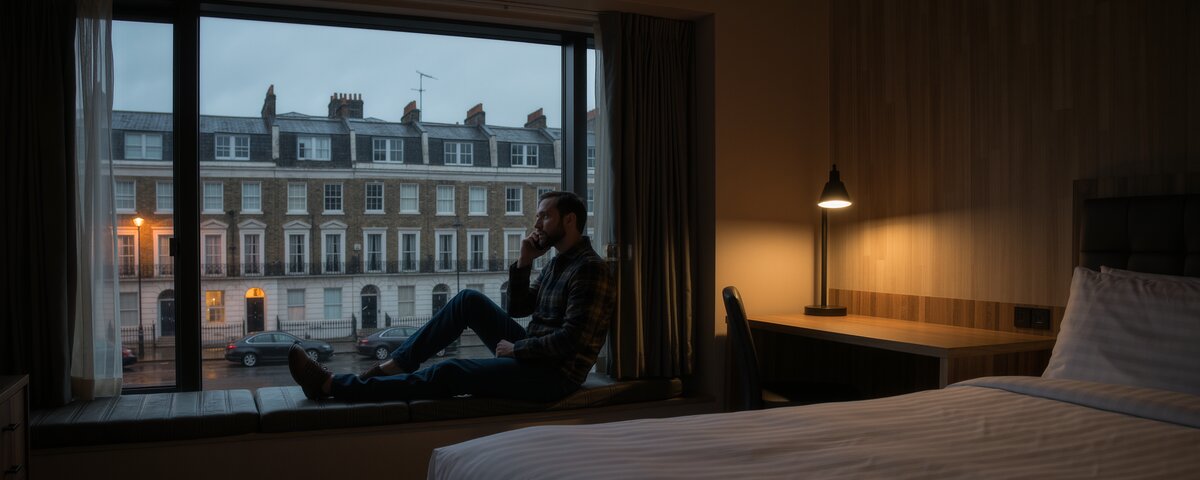
You are in London on a matter, a deal, a hearing or a project that was going to be three weeks and is now looking like seven. Your partner is at home, doing the school run or the dog or simply the whole of ordinary life on their own, and every evening there is a call. It is the best part of the day and it quietly organises everything else around it.
This is one of the situations that predicts a hard trip better than any job title. A partner at home changes what you feel allowed to do with an evening, and the guilt tends to push in the wrong direction.
01The trap: the evening becomes a waiting room for the call
The usual pattern goes like this. Work finishes late. You go back to the hotel because the call is at eight, or at nine, or whenever the children are down. You eat something in the room so you are there for it. The call is lovely and it ends, and it is ten o'clock and you have not spoken to a single person all day who was not a colleague or a voice on a phone.
Do that for a week and it is fine. Do it for five and two things happen. You get flat and slightly strange, which your partner can hear. And you start to resent the call a little, which is the last thing either of you wants.
02Why staying in is not loyalty
A lot of people on a long trip carry a low-level feeling that if their partner is working hard at home, they ought not to be out enjoying themselves. It is a decent instinct and it produces a bad result. Your partner almost certainly does not want you sitting alone in a hotel room as a kind of solidarity. They want you to come home in one piece and to be good company on the phone in the meantime, and a person who has had a conversation over dinner is better company than a person who has had room service in front of a laptop.
It helps to say this out loud, early, rather than to assume it. Most of the friction on long trips comes from each side imagining the other's evening rather than being told about it.
03Things that actually help
- Fix the call, and fix it so it does not own the evening. An early call before you go out, or a later one after, is better than a floating call that keeps you in the room waiting. If time zones are involved, pick the slot that works for both of you and stick to it, because a predictable call is easier on the person at home as well.
- Describe the evenings, including the dull ones. Tell them where you ate and who you spoke to. A partner who knows what your evenings actually look like worries less about both extremes: that you are miserable, or that you are having a much better time than they are.
- Choose evenings that are easy to explain. A class, a run club, a table of six at a restaurant, a museum late. Things with a clear shape are easier on everyone than an open-ended night out with people you met at the hotel bar.
- Protect the weekends home. If the firm is flying you back, do not let Friday flights slide to Saturday morning without a fight. The weekend is what makes the week survivable for both of you.
- Say when it is getting hard. Week four of a trip that was meant to be three is a reasonable moment to tell work that the end date matters to you. It is not unprofessional to ask.
04One fixed evening a week
If you do one thing, make it this: one evening a week that is booked, that is not work and that is not the call. Booked, because a standing arrangement survives a hearing day that overruns and a vague intention does not. Not work, because a working dinner with the other side of a deal or your own team is still work.
A booked dinner is one straightforward way to do it. KF.Social seats you at a table of six at a London restaurant on a set evening. KF.Social runs tables of six in London on weeknight evenings, sitting at 19:00, and the London page lists the dates on sale with the night and the area for each. It is a group dinner for making friends, not a date, and it finishes in good time for a late call home. The seat costs 15 pounds, which pays for the matching and not for the meal, and you pay the restaurant for your own food and drink.
The timings, because they matter when your week is not your own: booking closes six hours before, the restaurant lands about six hours before, and who you are sitting with about an hour before, when the group chat opens. If the week changes, cancelling 72 hours or more ahead returns the 15 pounds to your card, and inside 72 hours it does not come back. If the table does not run, everyone is refunded in full whatever the clock says. Booking gates on two things only: being 18 or over, and having paid. Everybody at the table booked and paid for their own seat exactly as you did.
See what is running in London.
05The short version
A partner at home makes a long trip harder in a specific way: the evening shrinks to the wait for the call. Fix the call so it does not own the evening, tell your partner what the evenings actually look like, and stop treating a night in the room as loyalty. One booked evening a week that is neither work nor the call will make you better company on the phone, which is the thing your partner actually wanted.
 KF.Social