 KF.Social
 KF.Social Editorial
Picture the last handful of times something good happened in your life. A birthday, a new job, a friend visiting, the end of a hard week. Now notice how many of those moments came attached to food. Cake, a meal out, a bottle opened, pastries brought in. Food and celebration have always gone together, but the modern version has quietly expanded until almost any occasion, and plenty of non-occasions, come with something to eat. This is not a personal failing. It is the product of deep social wiring meeting a food environment designed to sell you a reason to indulge.
The short version
- Eating with other people reliably increases how much you eat. In diary studies, meals with company were substantially larger than meals eaten alone.
- Sharing food is one of the oldest ways humans bond, so we are wired to eat more, and more happily, in a group.
- 'Treat culture' widened the list of things that count as a celebration until an ordinary Tuesday can qualify.
- Social eating norms are powerful: we match what the people around us are eating, often without noticing.
- You do not have to opt out of celebrating. You can keep the ritual meaningful and stop it becoming the default for every small thing.
The bond built into sharing food
Start with the part that is genuinely good. Eating together is one of the most reliable ways humans have ever found to build trust and belonging. Sharing a meal signals safety and cooperation, and for most of human history a feast was how a group marked that it had something worth marking. This instinct is not a problem to be solved. It is one of the better things about being human, and stripping food out of connection entirely would be a joyless mistake.
But the same wiring has a measurable side effect. Researchers who had people keep detailed diaries of everything they ate found a striking pattern: the more people present at a meal, the more each person ate. One companion was linked to a roughly third larger meal, and eating in a large group pushed meals to over 75 percent larger than eating alone. This is called the social facilitation of eating, and it happens quietly, without anyone deciding to overeat.
Meals with other people tend to last longer, and longer meals mean more chances to keep eating. Add relaxed attention, second helpings, and the pleasure of company, and the total climbs without any single choice feeling like too much.
How the list of occasions grew
Historically, a food celebration was rare by definition. A feast meant something precisely because most days were not feasts. What changed is not the human instinct but the number of things now labelled worth celebrating. A promotion, sure. But also finishing a project, getting through a meeting, it being Friday, it being payday, surviving Monday, or simply 'treating yourself' because the week was long.
Food companies noticed this and leaned on it hard. If a treat is something you earn for a big achievement, the market is small. If a treat is something you deserve for any mild effort, the market is every day. The message that you have earned an indulgence, that you owe it to yourself, turns the exception into the routine. The problem is not any single treat. It is that the category quietly swallowed the calendar.
| What used to warrant food | What now often does |
|---|---|
| A birthday or wedding | A birthday, plus the office version, plus the family version |
| A major holiday | The holiday, plus its build-up, plus its leftovers |
| A big personal win | Finishing an ordinary task or a hard-ish day |
| A rare feast | 'It is Friday' or 'I deserve this' |
Keeping the ritual, losing the drift
The aim here is not fewer celebrations or joyless ones. It is to keep food-based celebration meaningful by keeping it a little rarer, and to build a wider set of ways to mark good things so that eating is not the only tool in the box.
- Let the big ones be big. Genuine celebrations deserve the cake and the meal out. Eat them fully and without guilt. Guarding these is the whole point of not diluting them everywhere else.
- Notice the auto-treat. When 'we should celebrate' pops up for something small, pause and ask whether it is really an occasion or just a habit wearing an occasion's clothes.
- Build non-food rituals. Mark a win with a walk, a message to someone who would be proud, a small purchase you wanted, or simply saying it out loud. These can carry meaning too.
- Keep the connection, resize the food. You can still meet friends and share a table without every gathering being a maximal feast. The company is the point; the quantity is negotiable.
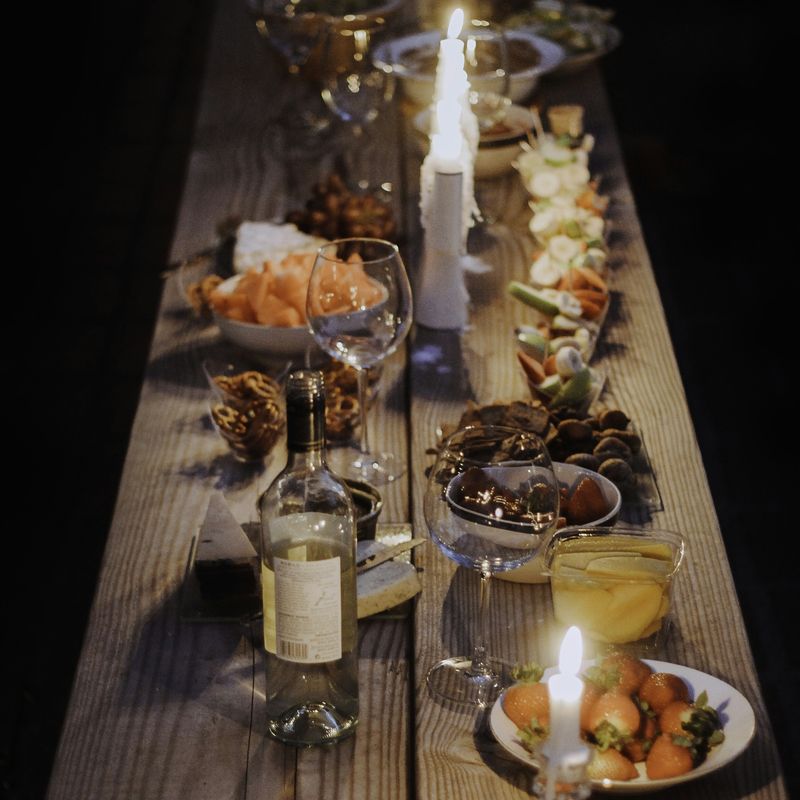
When food is the centre, make the spread something everyone can enjoy. A generous celebration table works just as well built around vegetables, dips, grains, beans, and fruit as around meat and cheese, and a plant-forward feast is a feast, not a compromise. Swapping a tray of sausage rolls for a big shared bowl of dressed lentils and roasted vegetables keeps the abundance and the ritual, it just shifts what the abundance is made of.
You are not trying to take food out of celebration. You are trying to stop every ordinary day from being reclassified as one. Protect the real occasions, and let the small stuff be marked in other ways.
Questions people ask
Is it bad to celebrate with food?
Why do I always eat more at gatherings even when I am not that hungry?
How do I say no to office treats without seeming rude?
What are good non-food ways to celebrate?
References
- de Castro JM, Brewer EM. Physiology & Behavior. The amount eaten in meals by humans is a power function of the number of people present. 1992. doi.org/10.1016/0031-9384(92)90212-K
- Herman CP. Appetite. The social facilitation of eating. A review. 2015. pubmed.ncbi.nlm.nih.gov/25265153
- Higgs S. Appetite. Social norms and their influence on eating behaviours. 2015. doi.org/10.1016/j.appet.2014.10.021
Last reviewed 18 July 2026. We check health-condition articles against current guidelines and update the date above when we do.
We eat what the room is eating
There is a third force layered on top: social norms. A large body of research shows that people adjust how much and what they eat to match the people around them, usually without realising it. If everyone is having dessert, having dessert feels normal and skipping it feels like a small act of rebellion. If the table orders a second round, the pull to join is strong.
This is why celebrations are so effective at driving intake. They gather a group, set an explicit norm that indulging is the point, and remove the social cost of eating more. Declining can feel like declining the occasion itself, as if a slice of cake were a vote for the birthday. It is not, but the feeling is real and it is worth naming so you can see it working.
The goal is not to become the person who refuses the cake and lectures the table. That is its own kind of unhealthy, and it makes food a source of stress. Enjoying a celebration is not a failure. The only thing worth changing is the drift where every ordinary day borrows the celebration's rules.